Glassblowing has a reputation for being expensive and dangerous, and both of those things are partly true. What surprises most beginners is how much of the difficulty is logistical rather than physical. You are not learning a delicate hand skill so much as learning to move confidently around equipment that is very hot and very unforgiving of hesitation.
This guide covers the honest path: what to learn first, what it costs, and which of the expensive decisions you can safely postpone.
Start with a class, not with equipment
The single best thing you can do is spend a weekend in someone else's studio before you buy anything. A beginner class gives you access to a furnace you did not have to build, a teacher who can stop you before you burn yourself, and most importantly a feel for whether you actually enjoy the process. Many people love the idea of glassblowing and discover that they dislike the heat, the noise and the standing.
Take at least two classes separated by a few weeks. The first class teaches your hands; the second tells you whether they remembered anything.
What to learn in your first month
Gather cleanly
A gather that comes out of the furnace even and bubble-free is the foundation of everything else. Practice until you can take the same size gather three times in a row.
Rotate without thinking
Constant rotation is what keeps glass on the pipe. Your hands should rotate the pipe while your attention is somewhere else entirely.
Blow a bubble you control
Learn to feel the resistance and stop inflating before the bubble reaches the size you want, not after.
Make one shape, repeatedly
A simple tumbler or a round paperweight, made twenty times, teaches more than twenty different shapes made once.
Almost every beginner mistake traces back to a paused pipe. Glass is fluid at working temperature and gravity never stops pulling on it.
The equipment you genuinely need
If you decide to continue, the shopping list divides into three tiers. Only the first tier is needed to make anything at all.
| Tier | What it covers | Rough order of cost |
|---|---|---|
| Essential | Blowpipe, gathering pipe, jacks, shears, tweezers, heat shield, gloves, eye protection | Low four figures |
| Core | Melting furnace with a crucible, glory hole, annealing oven, ventilation | Five to six figures |
| Convenience | Second crucible, colour bench, coldworking wheel, larger annealing chamber | Adds substantially |
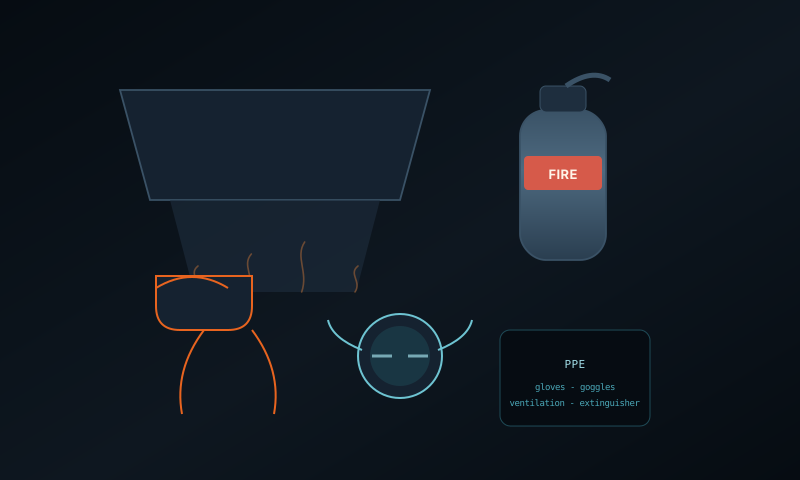
The ventilation is the item beginners most often try to skip, and it is the one that cannot be skipped. A furnace in an unventilated room produces carbon monoxide and metal oxide fumes. That is not a comfort issue, it is a poisoning issue.
Fit a carbon monoxide alarm in the room and test the capture velocity of your hood with a smoke pencil. If the smoke drifts sideways rather than up into the canopy, the extraction is not working.
Costs, honestly
Running a hot shop costs money continuously, not just at setup. A furnace that holds glass at 1150 °C draws significant power around the clock, and a crucible is a consumable that will need replacing within a year of daily use. Before committing to a home studio, add up electricity, gas, crucibles, annealing consumables and the occasional broken piece.
Many people find that renting time in a shared studio is better value for years. You get better equipment than you could afford alone, and you get other people to notice when you are about to do something dangerous.
Safety, without the drama
- Assume every surface near the furnace is hot, including the ones that look like painted metal.
- Wear natural fibres. Synthetics melt onto skin and turn a minor burn into a serious one.
- Keep a fire blanket and an appropriate extinguisher within reach of the bench, not across the room.
- Tie back long hair and remove loose jewellery before you approach the furnace.
- Never work alone when you are tired. Most studio accidents happen at the end of a long session.
Glassblowing rewards patience more than talent. The people who get good quickly are usually the ones who made the same simple form fifty times and paid attention to what changed.
This article is educational reference material. Hot glass work involves severe burn, fume and fire hazards. Wear eye protection, heat-resistant gloves and natural-fibre clothing, ventilate every heat source to open air, fit a carbon monoxide alarm, and take hands-on instruction before operating any hot glass equipment.
No guarantee of results. Techniques, temperatures and schedules described here are reference guidance based on common studio practice. Glass behaviour depends on your materials, equipment and technique. Test everything on your own setup and follow the manufacturer's instructions.