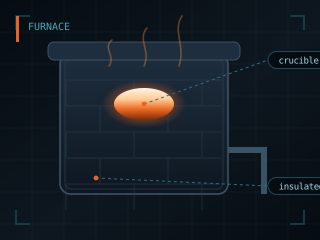
Glass Furnace
The melting tank that holds glass at working temperature, day and night, for the whole life of the studio.
Gathering
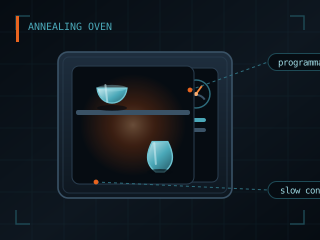
A front-loading chamber for bringing finished pieces down through the annealing range under control.
| Chamber volume | 60 - 400 L |
|---|---|
| Maximum temperature | 700 °C |
| Control accuracy | plus or minus 2 °C |
| Stored programs | 20 |
| Insulation | Low mass fibre board, 100 - 150 mm |
| Supply | 230 V single phase or 380 V three phase |
Compatibility assumes the tool is rated for the working temperature of that glass family. Check the maker's documentation before use.
An annealing oven, sometimes called a lehr or a front-loading kiln, holds a piece in the annealing range long enough for internal stress to relax, then cools it slowly enough that no new stress forms. The chamber is insulated on all six faces and controlled by a programmer rather than a simple thermostat, because the cooling rate matters far more than the top temperature.
Reference information only. Specifications are published ranges drawn from manufacturer documentation and normalised for comparison. They vary between makers and between individual units. This page does not sell or endorse any product, and does not guarantee any result. Follow the equipment manufacturer's instructions and take hands-on instruction before operating hot glass equipment.
The melting tank that holds glass at working temperature, day and night, for the whole life of the studio.
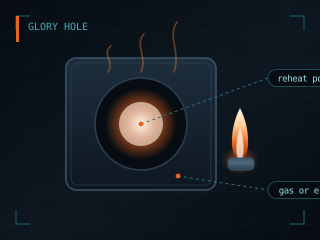
A reheating chamber that brings a cooling piece back to working temperature without touching the main furnace.
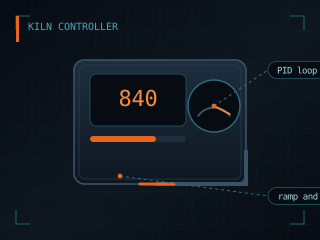
The programmer that executes a ramp-and-hold schedule and holds the furnace to it.
Read the category overview, or jump into the 3D Studio to see these tools applied to a live piece.