Every colourant added to glass carries its own coefficient of expansion. Mix two glasses with mismatched COE and the piece will look perfect when it comes out of the kiln, then crack days later along the colour boundary. Colour work starts with compatibility, not with palette.
Understanding COE
The coefficient of expansion describes how much a glass expands per degree of temperature change. As a piece cools, each component shrinks at its own rate. If the rates differ, the glass that shrinks more pulls the other into tension, and glass is far weaker in tension than in compression.
| Glass family | Typical COE | Safe pairing range |
|---|---|---|
| Soda-lime | Around 90 | Within 1 point of the base glass |
| Borosilicate | Around 33 | Within 1 point of the base glass |
| Lead crystal | Around 92 | Within 1 point of the base glass |
A soda-lime colour on a borosilicate base is not a subtle mismatch, it is a guaranteed failure. Test small before committing a large piece.
Frit: speckle and wash
Frit is crushed coloured glass graded by mesh size. A hot gather rolled across a tray of frit picks up a layer that fuses into the surface. Coarse grades give bold speckle; fine grades give an even wash. Mixing grades gives depth.
- Roll the gather while it is tacky but not dripping. Too hot and the frit sinks and disappears.
- Reheat after rolling to fuse the frit into the surface rather than leaving it sitting on top.
- Keep colours in sealed jars. Cross-contamination between jars ruins both.
Powder: gradients and depth
Powder is frit taken to mesh 100 to 200. It behaves like pigment: sifted from a height it settles into a soft gradient, and dusted between layers of clear it produces internal haze. Because the particles are tiny, powder fuses almost instantly and is very easy to over-apply.
Powder that looks faint on the marver reads strong once it is cased in clear. Start with half of what you think you need.
Oxide: colour at the source
Metal oxides are the raw colourants behind every coloured glass. Cobalt gives deep blue at a fraction of a percent; copper gives turquoise or ruby depending on oxidation; iron gives green and amber; manganese gives purple and is also used to decolourise.
They are added to the batch rather than applied to a gather, which means they change the working properties of the whole melt, including its expansion. A recipe that worked in clear needs its schedule rechecked after a colourant change.
Gold leaf
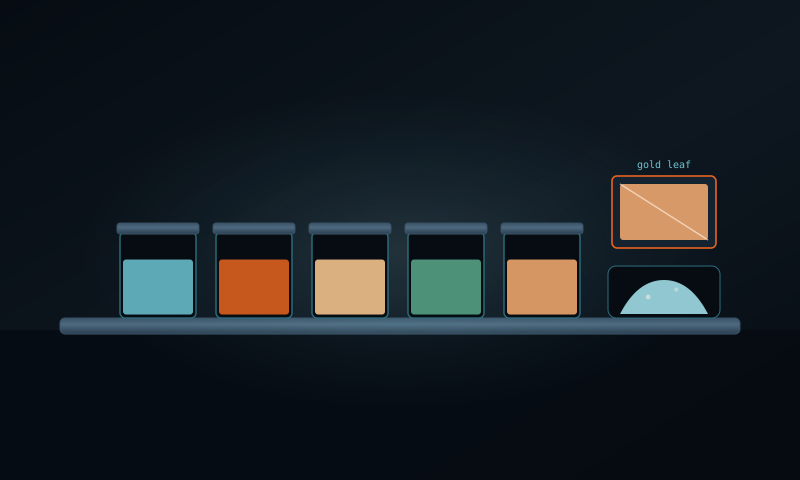
Gold leaf applied at 500 to 600 °C fuses into the glass surface and stays bright. Applied too hot it burns away; too cold it sits on the surface and wears off. It is used for rims, bands and accents rather than coverage.
A safe colour workflow
Confirm the COE of every material
Before it goes near a piece, know what it expands at. Test on a bead if the supplier number is uncertain.
Mask up for powder and oxide
Powder is the most airborne colourant and some oxides are hazardous by inhalation. A fitted respirator is required.
Apply in thin layers
Build colour gradually with reheat passes between. A thick single application traps bubbles and crazes.
Recheck the annealing schedule
Heavy colour layers change how heat moves through the wall. Thick colour work anneals more slowly.
Colour that survives is colour that matches. Once compatibility is handled, the palette is the easy part.
This article is educational reference material. Hot glass work involves severe burn, fume and fire hazards. Wear eye protection, heat-resistant gloves and natural-fibre clothing, ventilate every heat source to open air, fit a carbon monoxide alarm, and take hands-on instruction before operating any hot glass equipment.
No guarantee of results. Techniques, temperatures and schedules described here are reference guidance based on common studio practice. Glass behaviour depends on your materials, equipment and technique. Test everything on your own setup and follow the manufacturer's instructions.